
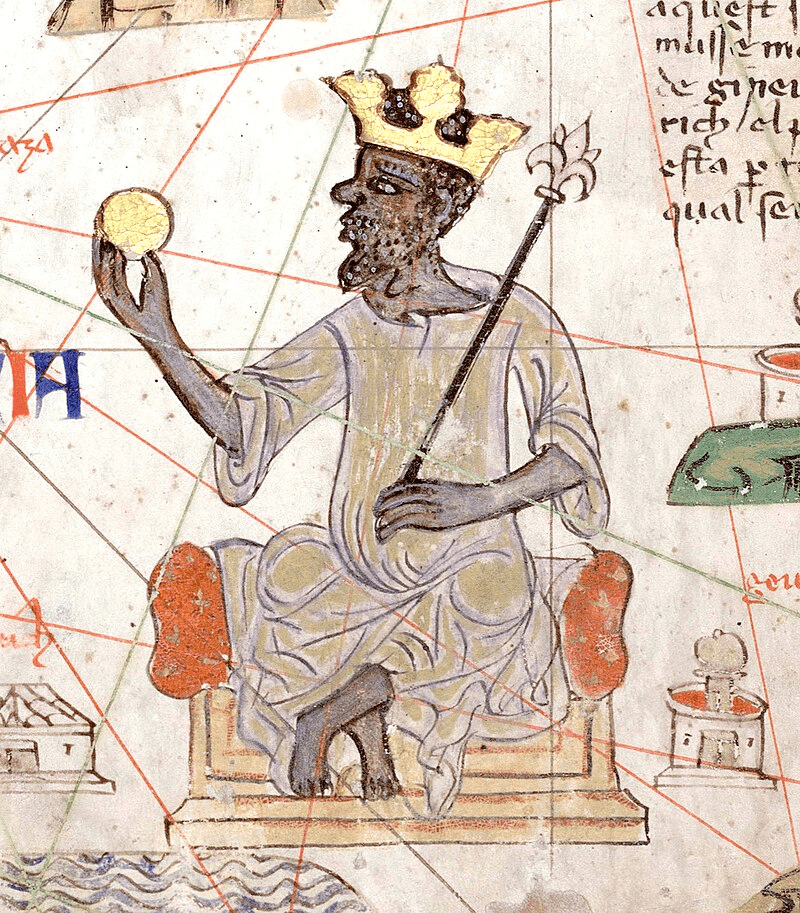
Detail showing Mansa Musa sitting on a throne and holding a gold coin. Image credit: By attributed to Abraham Cresques – This file comes from Gallica Digital Library and is available under the digital ID btv1b55002481n, Public Domain, https://commons.wikimedia.org/w/index.php?curid=107077167
In the annals of history, few rulers have ever wielded wealth with the benevolence and grandeur of Mansa Musa (c. 1280–1337 CE), the ruler of the Mali Empire. His riches were so vast that they altered economies, and his acts of generosity were so profound that they still resonate today. But Musa’s philanthropy was more than mere extravagance—it was a deliberate effort to uplift his people and enhance the cultural and intellectual landscape of West Africa.
Who Was Mansa Musa?
Mansa Musa ascended the throne of the Mali Empire in 1312, inheriting a realm rich in natural resources, particularly gold. At its peak, Mali controlled nearly half of the world’s gold supply, making Mansa Musa one of the wealthiest individuals in history. But he was more than just a king with immense wealth; he was a visionary leader with a deep commitment to education, religion, and infrastructure.
A Legendary Pilgrimage That Shook the World
One of the most well-documented episodes of Mansa Musa’s philanthropy is his legendary hajj (pilgrimage) to Mecca in 1324. This journey was no ordinary religious expedition—it was a display of wealth and generosity on an unprecedented scale. Accompanied by a caravan of 60,000 men, including 12,000 slaves, each adorned in Persian silk and carrying gold bars, Musa’s procession was an awe-inspiring sight. The caravan included 80 camels, each reportedly carrying 300 pounds of gold (around 136 kg).
But Mansa Musa’s most remarkable act was not his wealth—it was how he used it. Along the way, he distributed gold to the poor, funded the construction of mosques, and engaged in large-scale charity. In Cairo, Medina, and Mecca, his generosity was so overwhelming that it devalued gold for a decade, disrupting local economies. This unintended economic shock serves as a testament to the sheer scale of his philanthropy.
Building a Center of Learning: The University of Sankore
Mansa Musa’s most enduring contribution was to education and scholarship. Upon his return from Mecca, he transformed Timbuktu into a hub of knowledge and culture. The University of Sankore, which he helped expand, became one of the most significant centers of learning in the Islamic world, rivaling institutions in Cairo, Baghdad, and Cordoba.
Musa funded the acquisition of thousands of manuscripts, covering subjects like astronomy, medicine, mathematics, and theology. At its peak, the university’s library housed an estimated one million manuscripts, making it one of the largest in human history. Timbuktu’s scholars became renowned across Africa and the Middle East, attracting intellectuals from across the Islamic world.
Mosques and Infrastructure: Gifts to Future Generations
Beyond education, Mansa Musa invested heavily in infrastructure, building mosques, schools, and cities. Among the most famous is the Djinguereber Mosque in Timbuktu, constructed in 1327 with the help of Andalusian architect Abu Ishaq al-Sahili, whom Musa brought back from Mecca. This mosque still stands today, a testament to his vision and generosity.
He also funded trade routes, ensuring the prosperity of his empire, and provided for the welfare of his people through economic stimulation and urban development. His contributions solidified Mali’s reputation as a thriving economic and intellectual powerhouse.
The Legacy of Mansa Musa’s Philanthropy
Mansa Musa’s benevolence was not merely an act of lavish spending; it was a strategic investment in society. His wealth enabled the flourishing of education, architecture, and commerce, leaving a lasting legacy that shaped West Africa for centuries.
Even today, his story captivates economists, historians, and philanthropists. His life raises questions: How can wealth be used for the greater good? What defines true generosity? His actions serve as a reminder that the greatest leaders do not hoard wealth—they use it to uplift others.
As an old Malian proverb goes:
“A river does not drink its own water; a tree does not eat its own fruit. The wealth of a ruler is for the people.”
Mansa Musa exemplified this wisdom, ensuring that his riches enriched not only his empire but the entire world.
We’d love to know your thoughts
- What’s the most surprising fact you learned about Mansa Musa?
- If you had unlimited wealth, how would you use it to help others?
- Do you think modern billionaires are as generous as Mansa Musa? Why or why not?
About From the Heart
HeartBeat Blog’s From the Heart series is a heartfelt exploration of the many ways we can create a kinder world. Making a difference and paying it forward don’t have to follow a single path—just because someone chooses a different way to contribute doesn’t mean their impact is any less valuable. Acts of kindness, generosity, and positive change take many forms—some visible, some quiet, but all meaningful. True change happens when we acknowledge and respect the diverse ways people give back, whether through direct action, advocacy, education, or simply offering support in ways that might not be immediately obvious. Every effort counts, and the key is not to measure impact by our own standards alone but to recognise the many ways people strive to make the world better in their own way.
From the Heart captures this spirit through essays, opinions, poetry, non-book reviews, and musings—sharing both everyday and extraordinary moments that inspire change. Alongside these reflections, you’ll find news, event announcements, and updates from the Store with a Heart community, celebrating the many ways we can impact lives and lift one another up. Whether through personal stories, creative expression, or reflections on life’s small but meaningful acts, From the Heart offers an open space to inspire, connect, and celebrate the journey toward a better tomorrow.

Sam and the Home for the Aged by John Grey (A Poem)
What kind of life settles into poems written between countries and years? John Grey invites readers to discover the answer by reading the piece and letting its quiet weight unfold.
Keep reading
Announcing the Winners of the Universal Kindness Awards 2026
Let us congratulate the recipients of the Universal Kindness Awards 2026, honouring individuals and organisations who exemplify the power of kindness, compassion, and positive impact.
Keep readingSomething went wrong. Please refresh the page and/or try again.
Disclaimer
The content on HeartBeat, a blog by Store with a Heart, is intended for informational and entertainment purposes only. The views expressed by authors and contributors do not necessarily reflect those of Store with a Heart. While we strive for accuracy, we do not guarantee the completeness, reliability, or validity of any information shared. None of HeartBeat‘s write-ups are paid for by any of the individuals, organisations, or brands mentioned. Any ads or sponsored posts are clearly marked as such. For more details, please review our Full Disclaimer, Privacy Policy, and Terms of Service.
HeartBeat Links
Here are shortcuts to our content:
- Book Review Requests
- Book Review Requests Step 3
- Books with a Heart
- Content Submissions
- Editorial Team and Guidelines
- From the Heart: Stories, Reflections, and Inspiration for a Kinder World
- Heart to Heart: Inspiring Action, One Interview at a Time
- HeartBeat: Your Pulse of Positivity
- Important Announcement
- Memorabilia
- Memorabilia for Award Winners
- Our Blog’s Disclaimer
- Our Blog’s Privacy Policy
- Our Blog’s Terms of Service
- Purpose-driven Insights
- The Difference Makers
- Universal Kindness Awards Nomination Form Step 1 and Step 2
- Universal Kindness Awards Paid Nominations, Sponsorships, and Other Forms of Financial Support for the Awards
- Universal Kindness Awards Policy for Reporting on Awardees and Minimum Nominee Criteria
- Universal Kindness Awards Supporters
- Universal Kindness Awards – Nomination Policies
- Voluntary Contribution Policy
- Winners of the Universal Kindness Awards
Nominate for the Universal Kindness Awards

We are accepting nominations all year round. It’s free to repay kindness with kindness. There’s no cost to make a submission (unless you choose to voluntarily pay for the nomination and help pay it forward). Nominate a difference maker today!
❤️❤️❤️❤️❤️
Our Collective Impact
To know how our entire global community of generous individuals and participating platforms has been making a difference, click here.
❤️❤️❤️❤️❤️
Visit Store with a Heart‘s online shop today!
Make a difference with every carbon-neutral gift that makes a difference. Check out our products and services. As you are one of our valued community members, you can use the code SWAH10 to get your 10% discount on every purchase you make.
“No act of kindness, no matter how small, is ever wasted.” – Aesop
Copyright © 2020-2025 Store with a Heart®: Making a Difference. All Rights Reserved.
Discover more from HeartBeat Blog by Store with a Heart
Subscribe to get the latest posts sent to your email.
 HeartBeat Blog by Store with a Heart