
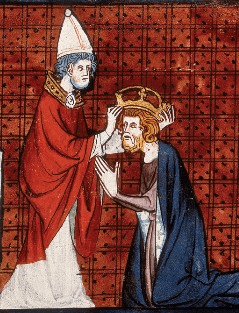
Image credit: By Anonymous – http://cache-media.britannica.com/eb-media/75/73475-004-01956CD5.jpg, Public Domain, https://commons.wikimedia.org/w/index.php?curid=9048906
When we think of philanthropy, our minds often drift toward modern billionaires donating vast sums to charity. But what if we looked back over a thousand years to an era where wealth wasn’t measured in stocks and bank accounts, but in land, influence, and power? Charlemagne (c. 747–814 CE), the King of the Franks and later Emperor of the Romans, was not just a warrior and statesman—he was also a medieval philanthropist. While the word “philanthropy” wasn’t used in his time, his actions in education, religious reform, and public welfare left a lasting legacy that mirrors the intentions of today’s great benefactors.
A King’s Commitment to Education
“To have another language is to possess a second soul,” Charlemagne is often credited with saying. While the authenticity of this quote is debated, his passion for learning was undeniable. Despite likely being illiterate for much of his life, Charlemagne championed the Carolingian Renaissance—a revival of art, culture, and intellectual pursuits across Europe.
One of his most significant philanthropic acts was the establishment of schools. With the help of scholars like Alcuin of York, Charlemagne set up palace schools and encouraged the spread of literacy among clergy and nobility. His reforms introduced the Carolingian minuscule, a standardized form of writing that made texts more readable and became the foundation of modern European scripts. Without his support, many classical texts from antiquity might have been lost forever.
Could one argue that Charlemagne’s patronage of learning was self-serving, meant to strengthen his rule? Perhaps. But in fostering an intellectual revival, he ensured that knowledge—something that benefits all societies—was preserved and passed down.
Public Works and Social Welfare
Charlemagne’s rule wasn’t just about conquest; it was also about governance. His reign saw the construction of roads, bridges, and churches—investments that benefited both the elite and the common people. He instituted capitularies, legal decrees that covered everything from trade regulations to agricultural practices, ensuring stability and fairness in economic life.
One remarkable example of his concern for social welfare was his initiative to provide food for the poor. During times of famine, he ordered grain stores to be distributed among the needy, showing a level of social responsibility that was rare for a medieval monarch. This echoes the sentiment of today’s philanthropic efforts to fight food insecurity.
Religious Philanthropy: A Double-Edged Sword
Charlemagne’s devotion to Christianity shaped much of his philanthropic work. He was a great benefactor of the Church, funding the construction of monasteries and cathedrals. He also supported the copying of biblical texts, ensuring their preservation for future generations.
However, his religious philanthropy had a darker side. His military campaigns often forced conversion upon conquered peoples, most infamously the Massacre of Verden (782 CE), where thousands of Saxons were executed for resisting Christianity. Was his philanthropy truly altruistic, or was it a tool for cultural domination? The answer lies somewhere in between—a ruler deeply committed to faith, but willing to impose it by any means necessary.
A Lasting Impact on Europe
By the time of Charlemagne’s death in 814, his empire spanned much of Western and Central Europe. His legacy as a “father of Europe” is still felt today, particularly in the realm of education and governance. The Holy Roman Empire, which emerged from his reign, would shape European history for centuries.
Even in his own time, Charlemagne was recognized as a figure of almost mythical significance. A famous quote attributed to him states, “Let my armies be the rocks and the trees and the birds in the sky.” Though likely apocryphal, it reflects the breadth of his influence—not just as a conqueror, but as a steward of civilization.
Was Charlemagne a Philanthropist?
If we define philanthropy as the love of humanity expressed through charitable actions, then Charlemagne fits the role—though imperfectly. His efforts to spread literacy, improve infrastructure, and care for the poor make him a forerunner of medieval philanthropy. At the same time, his philanthropy was often entwined with personal and political ambitions.
Would Europe have experienced the same intellectual and cultural revival without him? It’s impossible to say. But what is clear is that Charlemagne’s reign left an indelible mark on history—one that, like the finest acts of philanthropy, continues to benefit people long after his time.
Share Your Insights
What do you think about Charlemagne’s legacy? Was he a true philanthropist, or were his charitable acts just a means to strengthen his rule? History is rarely black and white, and your perspective matters! Share your thoughts in the comments:
- Do you think Charlemagne’s contributions to education and social welfare were purely altruistic or politically motivated?
- How do his efforts compare to modern philanthropists and world leaders?
- Which of his reforms do you think had the most lasting impact on Europe?
Let’s discuss! 🚀
About From the Heart
HeartBeat Blog’s From the Heart series is a heartfelt exploration of the many ways we can create a kinder world. Making a difference and paying it forward don’t have to follow a single path—just because someone chooses a different way to contribute doesn’t mean their impact is any less valuable. Acts of kindness, generosity, and positive change take many forms—some visible, some quiet, but all meaningful. True change happens when we acknowledge and respect the diverse ways people give back, whether through direct action, advocacy, education, or simply offering support in ways that might not be immediately obvious. Every effort counts, and the key is not to measure impact by our own standards alone but to recognise the many ways people strive to make the world better in their own way.
From the Heart captures this spirit through essays, opinions, poetry, non-book reviews, and musings—sharing both everyday and extraordinary moments that inspire change. Alongside these reflections, you’ll find news, event announcements, and updates from the Store with a Heart community, celebrating the many ways we can impact lives and lift one another up. Whether through personal stories, creative expression, or reflections on life’s small but meaningful acts, From the Heart offers an open space to inspire, connect, and celebrate the journey toward a better tomorrow.

Sam and the Home for the Aged by John Grey (A Poem)
What kind of life settles into poems written between countries and years? John Grey invites readers to discover the answer by reading the piece and letting its quiet weight unfold.
Keep reading
Announcing the Winners of the Universal Kindness Awards 2026
Let us congratulate the recipients of the Universal Kindness Awards 2026, honouring individuals and organisations who exemplify the power of kindness, compassion, and positive impact.
Keep readingSomething went wrong. Please refresh the page and/or try again.
Disclaimer
The content on HeartBeat, a blog by Store with a Heart, is intended for informational and entertainment purposes only. The views expressed by authors and contributors do not necessarily reflect those of Store with a Heart. While we strive for accuracy, we do not guarantee the completeness, reliability, or validity of any information shared. None of HeartBeat‘s write-ups are paid for by any of the individuals, organisations, or brands mentioned. Any ads or sponsored posts are clearly marked as such. For more details, please review our Full Disclaimer, Privacy Policy, and Terms of Service.
HeartBeat Links
Here are shortcuts to our content:
- Book Review Requests
- Book Review Requests Step 3
- Books with a Heart
- Content Submissions
- Editorial Team and Guidelines
- From the Heart: Stories, Reflections, and Inspiration for a Kinder World
- Heart to Heart: Inspiring Action, One Interview at a Time
- HeartBeat: Your Pulse of Positivity
- Important Announcement
- Memorabilia
- Memorabilia for Award Winners
- Our Blog’s Disclaimer
- Our Blog’s Privacy Policy
- Our Blog’s Terms of Service
- Purpose-driven Insights
- The Difference Makers
- Universal Kindness Awards Nomination Form Step 1 and Step 2
- Universal Kindness Awards Paid Nominations, Sponsorships, and Other Forms of Financial Support for the Awards
- Universal Kindness Awards Policy for Reporting on Awardees and Minimum Nominee Criteria
- Universal Kindness Awards Supporters
- Universal Kindness Awards – Nomination Policies
- Voluntary Contribution Policy
- Winners of the Universal Kindness Awards
Nominate for the Universal Kindness Awards

We are accepting nominations all year round. It’s free to repay kindness with kindness. There’s no cost to make a submission (unless you choose to voluntarily pay for the nomination and help pay it forward). Nominate a difference maker today!
❤️❤️❤️❤️❤️
Our Collective Impact
To know how our entire global community of generous individuals and participating platforms has been making a difference, click here.
❤️❤️❤️❤️❤️
Visit Store with a Heart‘s online shop today!
Make a difference with every carbon-neutral gift that makes a difference. Check out our products and services. As you are one of our valued community members, you can use the code SWAH10 to get your 10% discount on every purchase you make.
“No act of kindness, no matter how small, is ever wasted.” – Aesop
Copyright © 2020-2025 Store with a Heart®: Making a Difference. All Rights Reserved.
Discover more from HeartBeat Blog by Store with a Heart
Subscribe to get the latest posts sent to your email.
 HeartBeat Blog by Store with a Heart
