
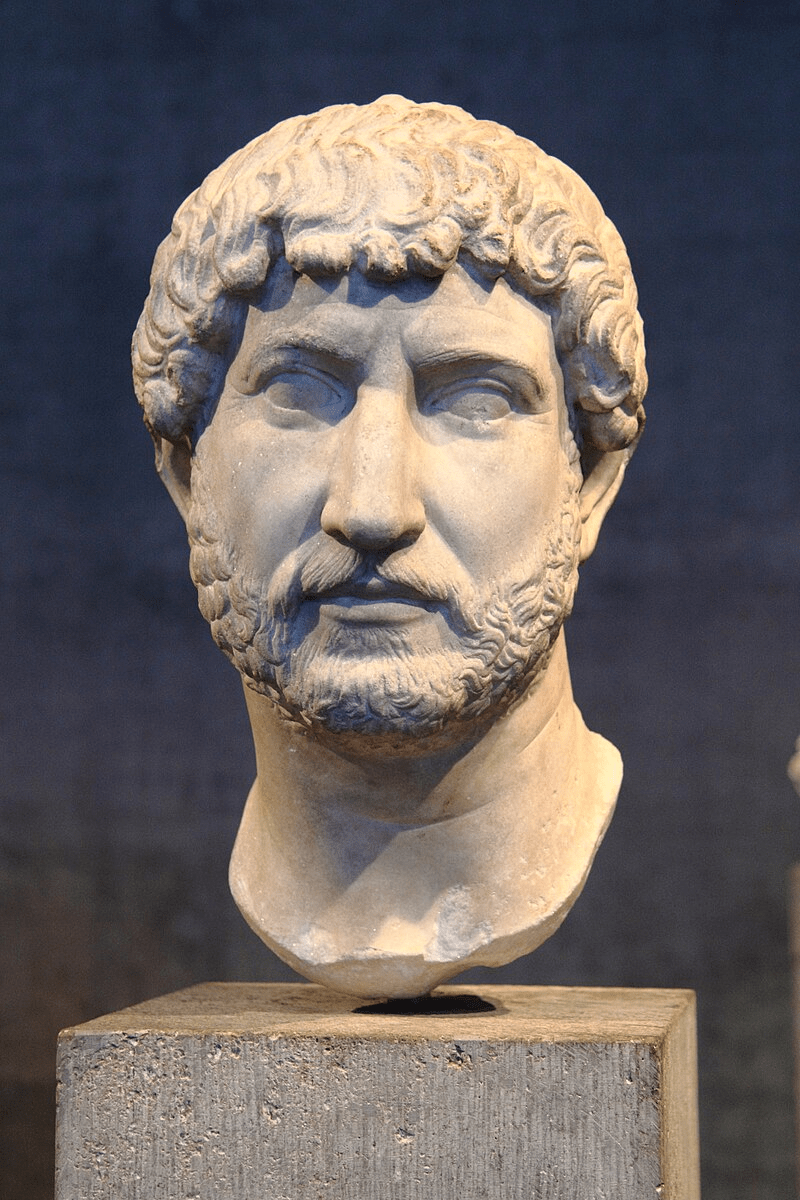
Photo credit: By Djehouty – Own work, CC BY-SA 4.0, https://commons.wikimedia.org/w/index.php?curid=85310985
What makes a ruler truly great? Is it military conquest, political power, or the lasting impact on people’s lives? Emperor Hadrian (76–138 CE), one of Rome’s most intriguing leaders, left behind more than just statues and walls—he left a legacy of compassion, reform, and cultural patronage. While many emperors sought to expand Rome’s borders through war, Hadrian focused on strengthening and enriching the empire from within. His commitment to public works, legal justice, and social welfare cements his place in history as not just a ruler, but a true philanthropist.
Hadrian the Builder: More Than Just a Wall
Hadrian’s love for architecture was not merely a pastime; it was an essential part of his governance. His most famous construction, Hadrian’s Wall, stretching 73 miles across northern Britain, was more than just a military defense. The wall provided a stable frontier, protecting settlements from raids while promoting trade and economic activity within the empire. Historian Anthony Everitt notes that Hadrian’s Wall was “the first time in Roman history that an emperor actively sought to secure rather than expand the empire” (Hadrian and the Triumph of Rome, 2009).
But Hadrian’s architectural vision extended far beyond military fortifications. He personally designed and funded public works, including aqueducts, roads, and temples. One of his greatest achievements was the reconstruction of the Pantheon in Rome, whose magnificent dome—142 feet in diameter—remains the largest unreinforced concrete dome in the world today. Scientific analysis of the Pantheon’s materials has revealed that Roman engineers used volcanic ash in the concrete mix, reducing weight while increasing durability, a technique that modern architects still study.
Hadrian even ensured his buildings served public needs. He funded large-scale baths and fountains, providing fresh water to thousands. In Athens, he completed the Hadrianic Aqueduct, a massive engineering feat that supplied water to the city for over 1,800 years—until it was finally shut down in the 20th century.
A Patron of Arts and Culture
While many Roman emperors saw Greek culture as either a threat or an exotic luxury, Hadrian embraced it wholeheartedly. He was a great admirer of Hellenistic philosophy, art, and literature. His passion for Greek culture earned him the nickname Graeculus (the “Little Greek”), a title some Roman elites mocked but one he wore with pride.
Hadrian did not just fund the arts—he actively participated in intellectual life. He wrote poetry, studied astronomy, and even engaged in debates with philosophers. His lavish villa at Tivoli, a sprawling retreat filled with artistic masterpieces, reflected his love for knowledge and beauty. His patronage extended to poets, sculptors, and scholars, ensuring that culture flourished under his rule.
Perhaps his most remarkable contribution was the Hadrianic reforms in law, which promoted fairness and human dignity. He abolished executions without trial, an act that challenged the brutality of his time. He also restricted the power of slave owners, forbidding them from killing or mistreating their slaves arbitrarily—a radical move in an empire built on slavery. His legal decisions were so influential that many of them later shaped Byzantine and even modern European legal traditions.
A Man of the People
Unlike many emperors who ruled from the comfort of Rome, Hadrian was one of the most traveled rulers in history. Over his 21-year reign, he spent more than half of it outside Italy, visiting nearly every province of the empire. Why? To understand the needs of his people firsthand. He walked among soldiers, dined with common citizens, and directly inspected infrastructure projects. How many leaders today would spend years personally engaging with their citizens rather than governing from a palace?
Hadrian’s travels were not merely symbolic. In North Africa, he personally ordered improvements to irrigation systems, boosting agricultural productivity. In Egypt, he supported the local economy by revitalizing Alexandria’s trade networks. His commitment to religious tolerance also stood out—he allowed diverse religious practices to continue, from Greek polytheism to Egyptian cults, as long as they did not threaten the empire’s stability.
Compassion in Personal Life: The Tragedy of Antinous
Hadrian’s personal life also reflected his deep humanity. His relationship with Antinous, a young Greek companion, remains one of history’s most famous love stories. When Antinous drowned in the Nile in 130 CE, Hadrian’s grief was overwhelming. He not only deified Antinous—a rare honor usually reserved for emperors—but also founded the city of Antinoöpolis in his memory. Scholars argue that this act was not just about personal loss but also about preserving a legacy of love and devotion. Hadrian’s mourning was deeply personal, yet he transformed it into a public act of commemoration, demonstrating his ability to merge personal emotion with philanthropic action.
A Philanthropic Legacy
Hadrian’s generosity extended beyond grand projects and personal grief. He actively supported orphans, funded food distributions for the poor, and implemented policies that eased the tax burden on struggling provinces. Roman historian Cassius Dio described Hadrian as a ruler who “governed with justice and wisdom, making the empire stronger not just through arms, but through his love for its people.”
His approach to governance was pragmatic rather than extravagant. While previous emperors depleted Rome’s treasury with endless military campaigns, Hadrian reduced unnecessary warfare, focusing instead on economic stability and social welfare. His decision to abandon Trajan’s aggressive expansionist policies saved countless lives and secured long-term prosperity for the empire.
Conclusion: Why Hadrian’s Philanthropy Still Matters
Hadrian’s reign challenges the modern perception that ancient rulers were merely power-hungry autocrats. He proved that leadership could be defined by generosity, cultural investment, and genuine concern for people’s well-being. His legal reforms laid the groundwork for more humane governance, his infrastructure projects improved daily life, and his patronage of the arts ensured that beauty and knowledge flourished.
The true measure of a leader is not just the battles they win but the legacy they leave behind. Hadrian’s impact can still be felt today, from the Pantheon’s enduring architecture to the echoes of his legal reforms in modern justice systems. At a time when many leaders prioritize short-term gains over lasting contributions, Hadrian’s story serves as a powerful reminder: true philanthropy is not about giving wealth—it’s about shaping a better world.
As Hadrian himself once wrote:
“Animula vagula blandula, hospes comesque corporis…”
(“Little wandering soul, gentle and companion of my body…”)
Even in his final words, Hadrian reflected on the fragility of life and the importance of leaving something meaningful behind. Few rulers have done so with as much vision, wisdom, and generosity as he did.
Join the Conversation!
Hadrian’s legacy offers valuable lessons on leadership, philanthropy, and cultural preservation. What can we learn from his reign in today’s world? Share your thoughts in the comments!
- Which of Hadrian’s contributions do you think had the most lasting impact?
- How does his leadership compare to modern political leaders?
- Do you believe a focus on culture and social welfare makes a ruler stronger or weaker? Why?
Let’s discuss! 🚀
About From the Heart
HeartBeat Blog’s From the Heart series is a heartfelt exploration of the many ways we can create a kinder world. Making a difference and paying it forward don’t have to follow a single path—just because someone chooses a different way to contribute doesn’t mean their impact is any less valuable. Acts of kindness, generosity, and positive change take many forms—some visible, some quiet, but all meaningful. True change happens when we acknowledge and respect the diverse ways people give back, whether through direct action, advocacy, education, or simply offering support in ways that might not be immediately obvious. Every effort counts, and the key is not to measure impact by our own standards alone but to recognise the many ways people strive to make the world better in their own way.
From the Heart captures this spirit through essays, opinions, poetry, non-book reviews, and musings—sharing both everyday and extraordinary moments that inspire change. Alongside these reflections, you’ll find news, event announcements, and updates from the Store with a Heart community, celebrating the many ways we can impact lives and lift one another up. Whether through personal stories, creative expression, or reflections on life’s small but meaningful acts, From the Heart offers an open space to inspire, connect, and celebrate the journey toward a better tomorrow.

Sam and the Home for the Aged by John Grey (A Poem)
What kind of life settles into poems written between countries and years? John Grey invites readers to discover the answer by reading the piece and letting its quiet weight unfold.
Keep reading
Announcing the Winners of the Universal Kindness Awards 2026
Let us congratulate the recipients of the Universal Kindness Awards 2026, honouring individuals and organisations who exemplify the power of kindness, compassion, and positive impact.
Keep readingSomething went wrong. Please refresh the page and/or try again.
Disclaimer
The content on HeartBeat, a blog by Store with a Heart, is intended for informational and entertainment purposes only. The views expressed by authors and contributors do not necessarily reflect those of Store with a Heart. While we strive for accuracy, we do not guarantee the completeness, reliability, or validity of any information shared. None of HeartBeat‘s write-ups are paid for by any of the individuals, organisations, or brands mentioned. Any ads or sponsored posts are clearly marked as such. For more details, please review our Full Disclaimer, Privacy Policy, and Terms of Service.
HeartBeat Links
Here are shortcuts to our content:
- Book Review Requests
- Book Review Requests Step 3
- Books with a Heart
- Content Submissions
- Editorial Team and Guidelines
- From the Heart: Stories, Reflections, and Inspiration for a Kinder World
- Heart to Heart: Inspiring Action, One Interview at a Time
- HeartBeat: Your Pulse of Positivity
- Important Announcement
- Memorabilia
- Memorabilia for Award Winners
- Our Blog’s Disclaimer
- Our Blog’s Privacy Policy
- Our Blog’s Terms of Service
- Purpose-driven Insights
- The Difference Makers
- Universal Kindness Awards Nomination Form Step 1 and Step 2
- Universal Kindness Awards Paid Nominations, Sponsorships, and Other Forms of Financial Support for the Awards
- Universal Kindness Awards Policy for Reporting on Awardees and Minimum Nominee Criteria
- Universal Kindness Awards Supporters
- Universal Kindness Awards – Nomination Policies
- Voluntary Contribution Policy
- Winners of the Universal Kindness Awards
Nominate for the Universal Kindness Awards

We are accepting nominations all year round. It’s free to repay kindness with kindness. There’s no cost to make a submission (unless you choose to voluntarily pay for the nomination and help pay it forward). Nominate a difference maker today!
❤️❤️❤️❤️❤️
Our Collective Impact
To know how our entire global community of generous individuals and participating platforms has been making a difference, click here.
❤️❤️❤️❤️❤️
Visit Store with a Heart‘s online shop today!
Make a difference with every carbon-neutral gift that makes a difference. Check out our products and services. As you are one of our valued community members, you can use the code SWAH10 to get your 10% discount on every purchase you make.
“No act of kindness, no matter how small, is ever wasted.” – Aesop
Copyright © 2020-2025 Store with a Heart®: Making a Difference. All Rights Reserved.
Discover more from HeartBeat Blog by Store with a Heart
Subscribe to get the latest posts sent to your email.
 HeartBeat Blog by Store with a Heart